Solutions by facility
Warehouse Safety Mirrors: Rack Tunnel Aisles, Intersections, and Docks
A warehouse with tunnel aisles cut through its pallet racking needs a 180-degree DomeVex mirror mounted flush on the inside rack upright, at the driver's eye level, at every opening where the tunnel meets a cross aisle. The manufacturer's tunnel rack sheet calls cross-aisle traffic in these tunnels a problem that has gone unprotected in the past, and sizes the fix at one foot of viewing distance per inch of mirror diameter. Full domes cover the open four-way intersections, and convex mirrors cover the dock and the pedestrian doors.
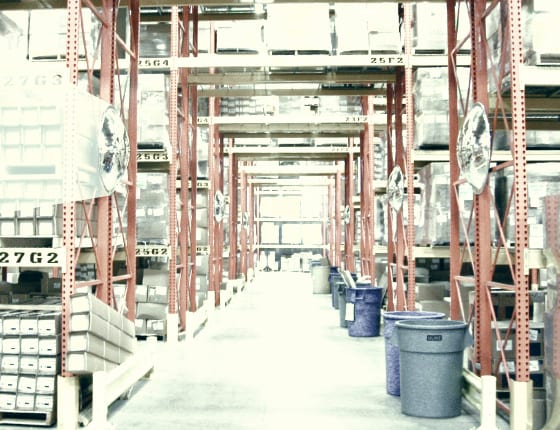
Storage racking turns a warehouse floor into a grid of corridors. The tunnel aisles that cut crosswise through the rack rows save forklifts a long detour around the end of the row, but they also box the driver in: pallets on both sides, nothing to see until the forks are already in the cross aisle. The manufacturer's tunnel rack sheet is blunt about it — cross-aisle traffic creates a big problem in tunnel-type aisles, and these areas have been unprotected in the past.
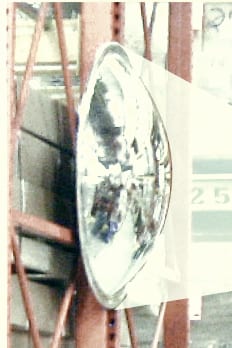
The fix the sheet describes is specific. A DomeVex mirror mounts flush against the inside rack upright, at eye level, so the driver gets a quick look at blind-spot traffic before entering the cross aisle. Its 180-degree viewing angle warns of traffic entering the tunnel from multiple rack aisles at once, and the placement diagram repeats the same mirror at every tunnel opening in the grid.
Tunnels are not the only blind spots in a warehouse, so this page also covers the open intersections, the dock, and the doors where people on foot step into the path of a lift truck. Everything here is acrylic or polycarbonate, made in the USA, and ships with its bracket.
Where the blind spots are
Where warehouse blind spots are, and what to mount there
Ride each route a forklift actually takes, and mark every point where the driver has to commit before seeing. In a racked building most of those points fall into five groups.
Spot 1
Tunnel aisles through the racking
- The problem
- A tunnel aisle runs crosswise through the rack rows, with loaded pallets for walls. The driver inside the tunnel cannot see traffic in the rack aisles it crosses, and drivers in those aisles cannot see the truck about to come out of the tunnel.
- The mirror
- A DomeVex wide-view mirror mounted flush against the inside rack upright at the opening, at the driver's eye level — the manufacturer's own placement for tunnel racks. Its 180-degree view shows both directions of the cross aisle from one mirror, up to 75 feet each way on the larger sizes, so the driver checks it in the stride of normal travel instead of creeping out blind.
Spot 2
Open four-way intersections
- The problem
- Where two main travel aisles cross in open floor, traffic comes from four directions and a single aimed mirror cannot show them all.
- The mirror
- A full dome mirror on the ceiling over the intersection. The full dome shows all four approaches at once, so every driver entering the crossing sees the other three directions in the same glance. Use the sizing guide to match the dome to the aisle widths; in high buildings, mount at the lowest practical point so the image stays large.
Spot 3
End-of-aisle T junctions
- The problem
- Every rack aisle ends in a T against the perimeter aisle. A truck leaving the rack aisle crosses the path of traffic running the perimeter, and the last bay of racking blocks the view both ways.
- The mirror
- A half dome mirror mounted flat at the end of the row, facing down the rack aisle. The half dome's 180-degree view shows the full perimeter aisle, left and right, to the driver coming out. Where the junction carries heavy two-way traffic, treat it like a tunnel opening and use a DomeVex on the end upright instead.
Spot 4
Loading dock and staging lanes
- The problem
- The dock mixes everything at once: trucks backing in, forklifts shuttling between trailer and staging, and people on foot checking paperwork between them. Stacked staging pallets block sightlines that were clear an hour before.
- The mirror
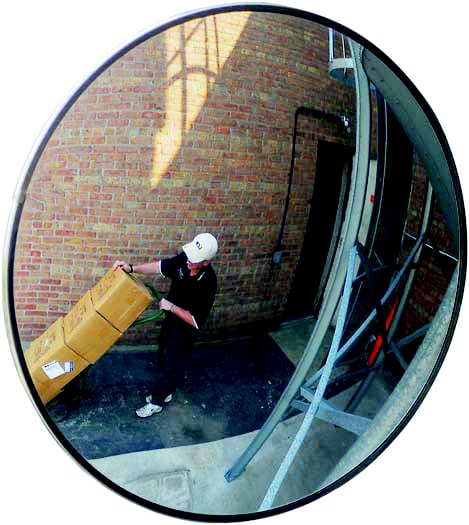
- An indoor convex mirror at each corner where a staging lane meets the travel aisle, and a heavy-duty rectangular convex where dock doors, ducts, or conveyors leave no room for a round mirror — the manufacturer lists loading areas as an intended use for the rectangular line. Outside the doors, use the outdoor DomeVex or an outdoor convex on the apron where the yard traffic crosses.
Spot 5
Pedestrian doors and walkways
- The problem
- Breakroom, office, and restroom doors open straight into travel aisles. The person stepping out is looking at a phone or a clipboard, not at the aisle, and the lift driver cannot see the door swing until it is in the lane.
- The mirror
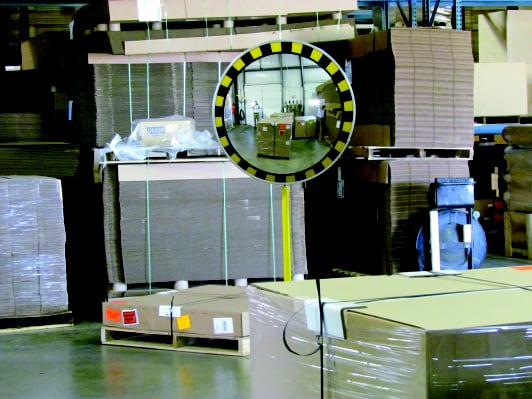
- A safety-border convex mirror beside each door, angled so the person stepping out sees the aisle in both directions. The yellow and black striped rim draws the driver's eye and marks the crossing at the same time. Where mirrors are likely to be clipped by loads, choose the polycarbonate lens, which does not shatter.
Recommended mirrors
Mirrors we recommend for warehouses
These are the catalog items behind the manufacturer's tunnel rack sheet, plus the dome and convex models that cover the rest of a racked building.
Indoor · Acrylic · Hardboard
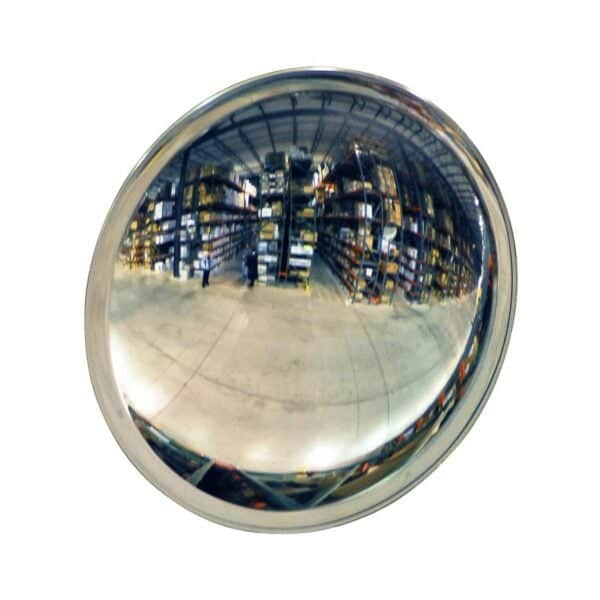
Indoor Acrylic DomeVex Convex Mirror
Why for warehouses: The tunnel rack mirror. Mounts flush on the inside rack upright at eye level; 180 degrees of view in 16, 24, 32, and 42 inches.
Outdoor · Acrylic · Plastic back
Outdoor Acrylic DomeVex Convex Mirror
Why for warehouses: The same 180-degree mirror on an outdoor-rated back, for dock aprons, yard lanes, and unheated buildings.
Full dome · Acrylic · Four-way intersections
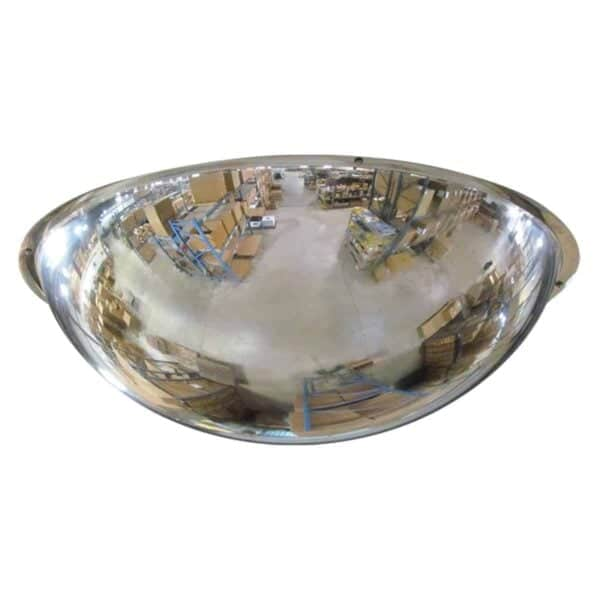
Acrylic Full Dome Mirror
Why for warehouses: For open four-way intersections of the main travel aisles. One ceiling-mounted dome shows all four approaches.
Half dome · Acrylic · T-intersections
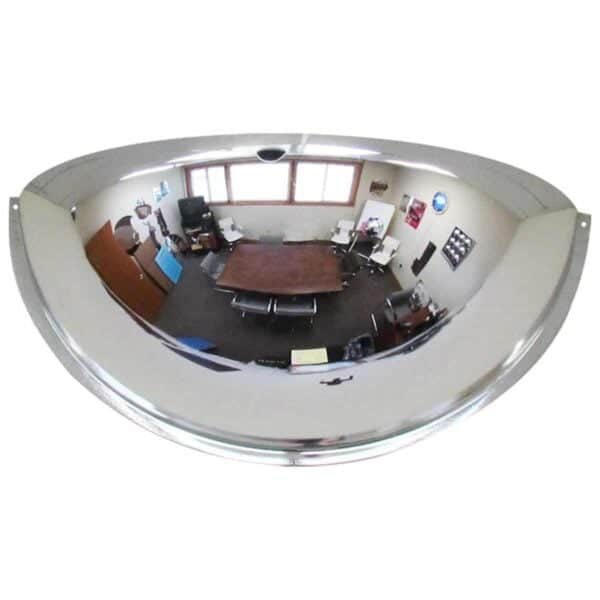
Acrylic Half Dome Mirror
Why for warehouses: For end-of-aisle T junctions and walls. 180 degrees from a flat mount, so the driver leaving the rack aisle sees the whole perimeter lane.
Indoor · Acrylic · Hardboard
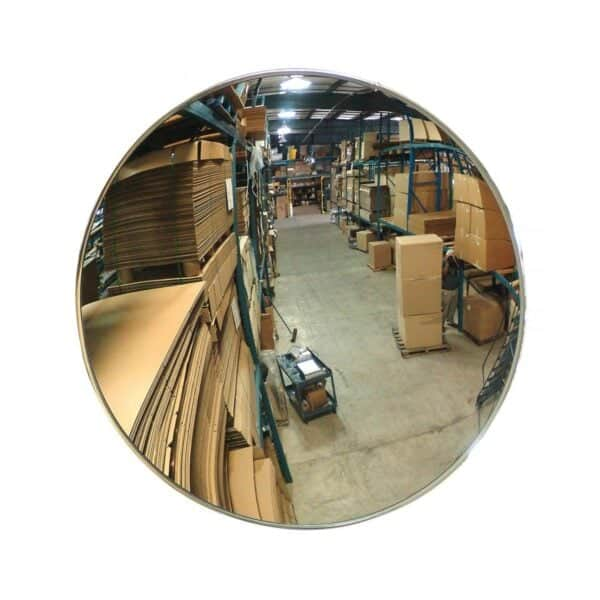
Indoor Acrylic Convex Mirror — Hardboard Back
Why for warehouses: The general-purpose corner mirror for staging lanes, dock corners, and machinery blind spots. Acrylic on a hardboard back, 12 to 36 inches.
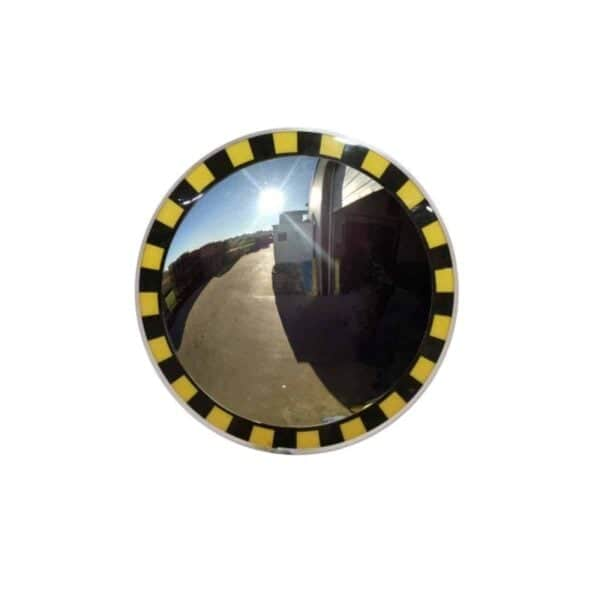
Indoor · Acrylic · Hardboard
Indoor Acrylic Convex Mirror — Safety Border
Why for warehouses: For pedestrian doors and marked walkway crossings. The striped rim marks the crossing and draws the driver's eye.
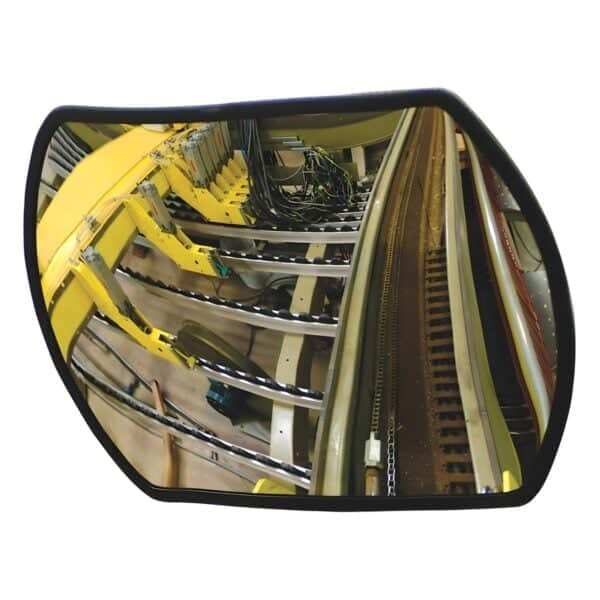
Indoor · Acrylic · Hardboard
Indoor Acrylic Rectangular Convex Mirror — Hardboard Back
Why for warehouses: For low clearance under dock doors, ducts, and conveyors. The manufacturer lists loading areas among its intended uses; 12 × 18 to 24 × 36 inches.
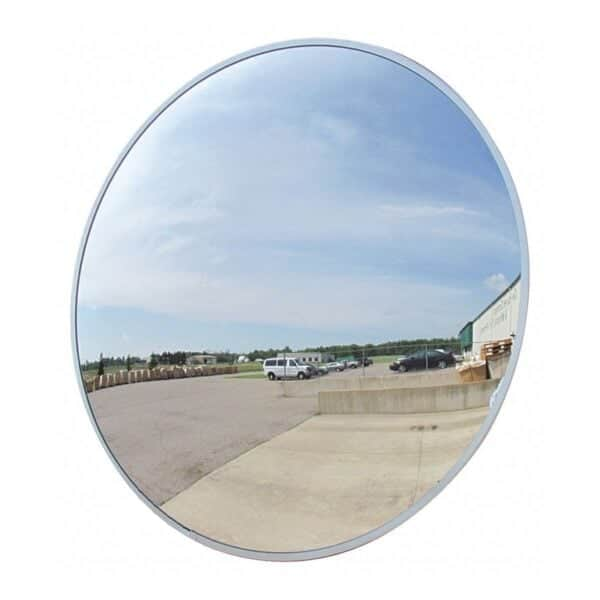
Indoor · Polycarbonate · Hardboard
Indoor Polycarbonate Convex Mirror — Hardboard Back
Why for warehouses: For aisles where loads swing wide and mirrors get hit. Polycarbonate does not shatter.
More about warehouses
180°
DomeVex view across the tunnel opening
16″–42″
four DomeVex sizes, indoor and outdoor
1 ft per inch
of diameter, the manufacturer's sizing rule
75 ft
of viewing in each direction on the largest sizes
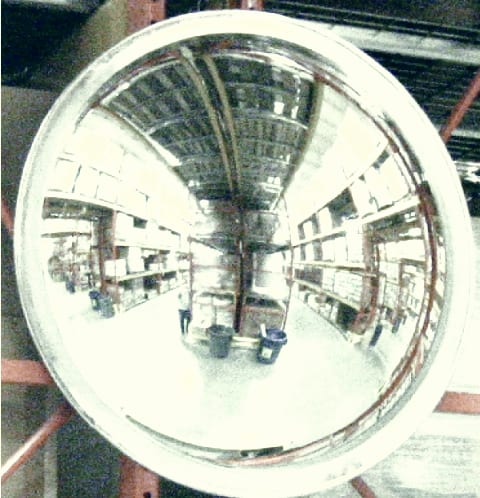
Sizing
Sizing tunnel rack mirrors
The manufacturer's rule for the DomeVex line is about one foot of viewing distance per inch of mirror diameter. Measure from the mirror position on the upright to the farthest point of cross-aisle traffic the driver needs to see, and round up — the sheet's standing advice is the largest mirror the location will take.
| Sight distance the driver needs | DomeVex size | Typical spot |
|---|---|---|
| Up to about 16 ft | 16″ | Narrow tunnel opening with slow, one-way cross traffic |
| 16 to 24 ft | 24″ | Standard rack tunnel intersection |
| 24 to 32 ft | 32″ | Wide cross aisle with two-way forklift traffic |
| 32 ft and up | 42″ | Main cross aisles and long sightlines — up to 75 ft of viewing each direction |
Sizes 16 to 32 inches ship UPS; the 42-inch DomeVex ships by truck freight. For a building-wide count — one mirror per tunnel opening adds up fast — contact us for a quote on quantity and freight together.
Mounting
Mounting on rack uprights
Tunnel rack mirrors mount to the racking itself, not to walls or the ceiling. Every mirror here ships with its bracket.
- 1
Map the tunnel openings
Walk or ride every tunnel and mark each point where it meets a rack aisle. The manufacturer's placement diagram puts a mirror at every opening where cross traffic appears, so the mirror count is the intersection count — budget from the map, not from memory.
- 2
Mount flush on the inside upright, at eye level
The sheet's instruction is exact: flush against the inside rack upright, at eye level, so the driver gets a quick look at blind-spot traffic without stopping. Eye level means the seated driver's eye height on the trucks you actually run, not a standing person's.
- 3
Aim it from the seat
Have a driver stop at the decision point while a second person adjusts the mirror until both directions of the cross aisle show. The mounting guide covers the bracket options if the upright face is obstructed.
- 4
Match the model to the spot
Indoor DomeVex models cover heated buildings; the outdoor model covers docks, aprons, and cold storage approaches. For the open intersections and doors, see the convex versus dome guide to pick the right shape for each spot.
In place
What the mirror sees in a warehouse
Questions
Questions we get about warehouses
What mirror goes in a warehouse rack tunnel aisle?
A DomeVex 180-degree mirror, mounted flush against the inside rack upright at the driver's eye level — that is the manufacturer's own specification for tunnel racks. Its wide view warns the driver of traffic entering the tunnel from multiple rack aisles, both directions from one mirror. Sizes run 16, 24, 32, and 42 inches, in indoor and outdoor models.
What size DomeVex does a tunnel intersection need?
The manufacturer's rule is about one foot of viewing distance per inch of mirror diameter: a crossing where the driver needs to see 24 feet takes a 24-inch mirror. Most rack tunnel openings take 24 or 32 inches; the 42-inch covers main cross aisles with up to 75 feet of viewing in each direction. When in doubt, go up a size.
How many mirrors does a racked warehouse need?
Count the tunnel openings. The manufacturer's placement diagram puts one mirror at every point where a tunnel meets a rack aisle, so a building with three tunnels crossing eight rack aisles has twenty-four openings to cover, before the dock and the doors. Walk the map first, then ask us for a quantity quote rather than ordering a few at a time.
Why not hang a dome from the ceiling instead?
Inside a rack tunnel there is loaded racking overhead, so a ceiling dome has nothing to see and nowhere useful to hang. The DomeVex sits flush on the upright at eye level, where the driver is already looking. Full domes still belong over the open four-way intersections of the main aisles, where the ceiling view works.
Do forklift mirrors work in freezer or outdoor sections?
Use the outdoor DomeVex model or an outdoor-rated convex at dock aprons, yard lanes, and unheated sections — the outdoor backing handles moisture that would swell an indoor hardboard back. The backing guide walks through the options.
What protects pedestrians on the warehouse floor?
Mirrors at the places where people on foot meet truck traffic: a safety-border convex beside every door that opens into a travel aisle, and at marked walkway crossings. The striped rim marks the crossing for the driver and gives the person stepping out a view of the aisle before the door swings.
How do large warehouse mirrors ship?
DomeVex mirrors 16 to 32 inches and convex mirrors up to 36 inches ship UPS. The 42-inch DomeVex and the 48-inch convex ship by truck freight. Multi-mirror orders for a full building are usually cheapest quoted as one freight shipment — contact us with your count.
Other facilities
Mirrors for other kinds of buildings
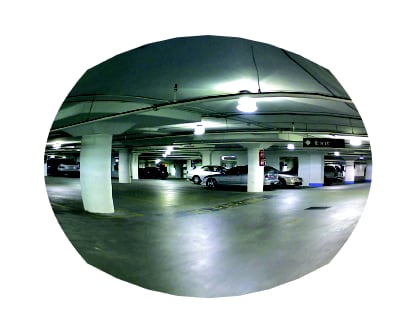
Parking Garages
A parking garage needs a convex mirror at every point where a driver has to commit to a turn without seeing what is around it: ramp turns, the exit onto the street, aisle corners at colum…
See the mirrors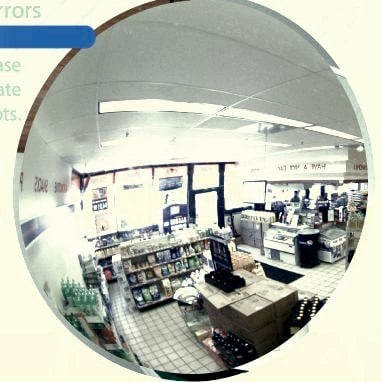
Convenience Stores
A convenience store needs two kinds of mirror: a dome mirror or DomeVex wide-view mirror mounted where the clerk can see the whole sales floor from the register, and smaller convex mirror…
See the mirrorsRelated guides
Guides that go with this page
Dome mirror sizing guide
How viewing distance maps to mirror diameter across the dome and DomeVex lines.
Dome mirror mounting options
Bracket and surface options for domes and DomeVex mirrors, including rack and wall mounts.
Convex versus dome mirrors
Which shape fits which blind spot — aimed convex, 180-degree half dome and DomeVex, or 360-degree full dome.
Lens material guide
Acrylic versus polycarbonate for aisles where loads swing wide and mirrors get hit.
Shop the categories
Every mirror on this page, by category
DomeVex mirrors
The 180-degree tunnel rack line: 16 to 42 inches, indoor and outdoor, flush rack-upright mounting.
Dome mirrors
Full, half, and quarter domes for intersections, T junctions, and corners.
Indoor convex mirrors
Aimed corner mirrors for staging lanes, dock corners, and pedestrian doors.
Rectangular convex mirrors
Low-clearance mirrors for dock doors, ducts, and conveyor runs.
Placement and sizing on this page follow the application sheets published by the manufacturer of our mirrors, Se-Kure Domes & Mirrors, and the specifications of the products in our catalog. Sizes and materials named here are the ones we stock; if your building needs something the sheet does not cover, call and we will work it out with you.
Free sizing help
Send us a photo of the corner and we will tell you what fits
A picture from where the person stands, plus a rough distance to the spot you cannot see, is usually enough for us to name the mirror, the size, and the bracket.