Understanding Dome Mirror Sizing
Published July 27, 2026 - Last updated September 4, 2026
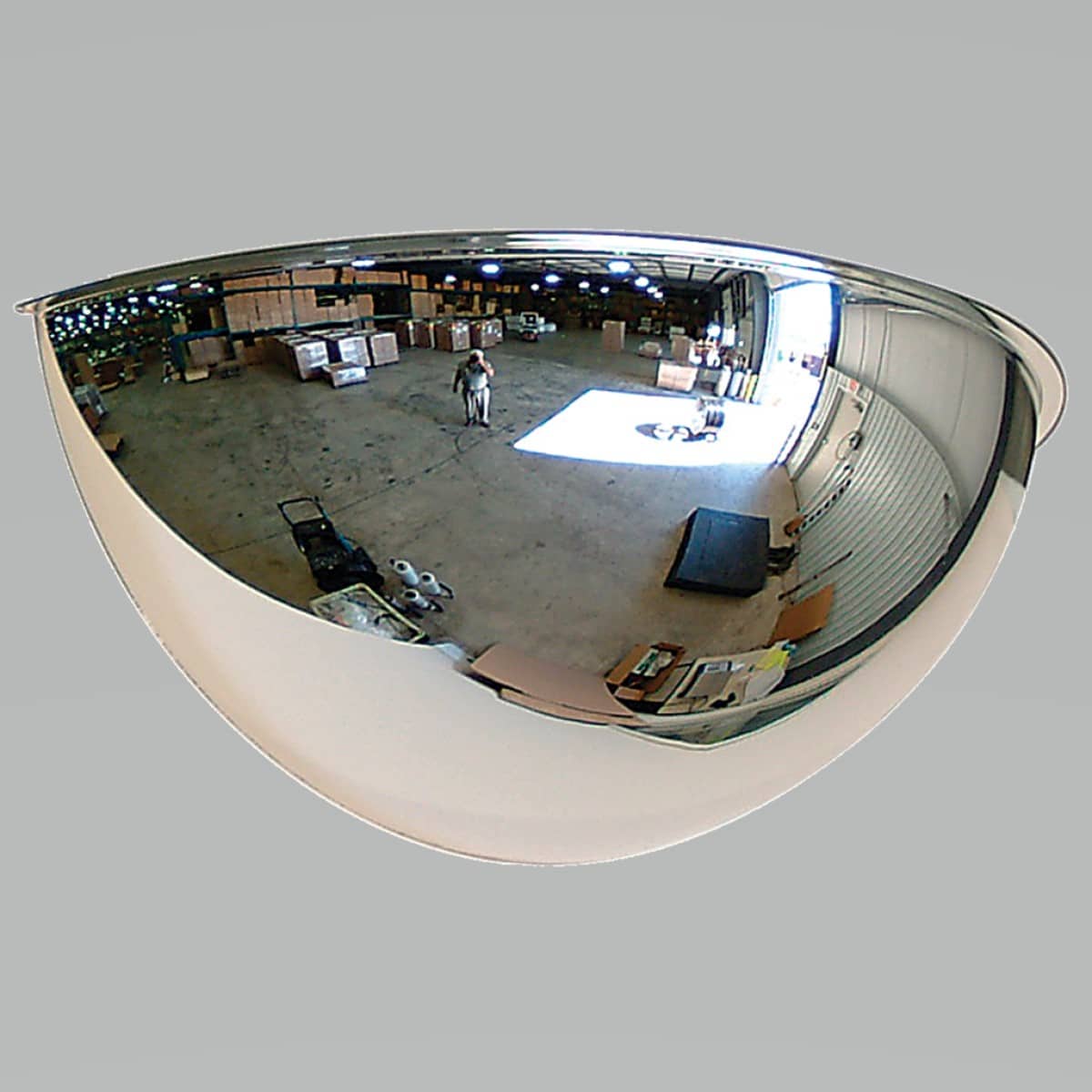
Dome size isn't just a number — it's a relationship between diameter and mount height that determines how much floor area you cover and how much detail you can see in the mirror. Get both right and one dome covers an entire intersection. Get them wrong and you either oversize and waste detail, or undersize and leave blind spots.
The two sizing variables
- 1. Dome diameter — the widest dimension of the curved surface, in inches. Common sizes: 18", 24", 32", 36", 48". Bigger diameter = more total area visible in the mirror at a given mount height.
- 2. Mount height — how far above the floor (or workspace) the dome sits. Common range: 7–14 feet depending on application. Higher mount = larger floor area covered, but less per-square-foot detail.
A 32" full dome at 8 feet covers a tight, high-detail intersection. The same 32" dome at 14 feet covers a much larger intersection but trades away the fine detail. Same dome, totally different coverage.
Sizing reference table
| Dome diameter | Mount height | Approx. coverage radius | Best for |
|---|---|---|---|
| 18" | 7–8 ft | 8–10 ft | Hallway corners, office aisles, small retail aisle ends, ATM corners |
| 24" | 8–10 ft | 10–14 ft | Standard retail intersections, school corridors, hospital hallways |
| 32" | 10–12 ft | 14–18 ft | Open retail floors, warehouse 3-way intersections, gymnasiums |
| 36" | 11–13 ft | 16–20 ft | Warehouse 4-way intersections, mid-size distribution hubs |
| 48" | 12–14 ft | 20–24 ft | Large distribution centers, school cafeterias, big-box retail crossings |
Coverage radius is the approximate distance from the mount point to the edge of useful floor visibility. Detail at the edge is always lower than detail directly under the dome.
Sizing by use case
Retail loss prevention. The right dome lets a single staff member watch multiple aisles at once. A 32" full dome at 9–10 feet over a three-aisle intersection covers the convergence point with enough detail to identify hand movements at the edges. Don't oversize — a 48" dome at the same mount height trades away the per-square-foot detail you actually need for loss prevention.
Warehouse safety. Forklift intersections need broader coverage and don't need fine detail — you're watching for vehicle and pedestrian presence, not facial recognition. A 36" full dome at 12 feet over a four-way forklift intersection is a good starting point. Step up to 48" for distribution-center hubs with 14+ foot ceilings.
Schools and hospitals. Corridor intersections and stairwell approaches benefit from half or three-quarter domes more than full domes (most school and hospital corridors are wall-adjacent T or three-way junctions, not open four-ways). A 24" half dome at 9 feet covers most of these intersections with high detail. Acrylic is fine here — impact risk is generally low.
Distribution centers. Larger ceilings, longer sightlines, and forklift speed all push sizing up. A 48" full dome at 14 feet covers a roughly 22-foot-radius intersection — adequate for most main-aisle hubs. For very large facilities, a row of 36" domes at adjacent intersections often outperforms a single oversized dome.
Common sizing mistakes
- Oversizing for the mount height. A 48" dome at 8 feet doesn't cover much more than a 32" dome at 8 feet — the limiting factor is mount height, not diameter. Buy the bigger dome only if the ceiling height supports it.
- Mounting too high. A dome that's technically "the right size" on paper but mounted 4 feet too high is too far to see useful detail in. If the ceiling is taller than the recommended mount height, suspend the dome on a chain to the right working height.
- Buying full dome where half or three-quarter is the right answer. A full dome mounted to a wall wastes the half facing the wall. Walk the intersection and count approach directions before ordering.
- Mixing format and size. Format (quarter / half / three-quarter / full) and diameter are independent decisions. Pick format from approach count; pick diameter from intersection size and mount height.
Frequently asked questions
How is dome mirror size measured?
Dome mirror size is measured by the diameter of the dome itself — the widest dimension of the curved viewing surface. An 18-inch dome has an 18-inch diameter; a 32-inch dome has a 32-inch diameter. Note this is different from quarter, half, three-quarter, and full dome formats, which describe coverage angle (90°, 180°, 270°, 360°) — diameter and format are independent decisions.
Does dome diameter alone determine coverage?
No. Dome coverage depends on diameter and mount height together. A 32-inch full dome at 12 feet of ceiling height covers a different floor area than the same 32-inch dome at 9 feet. Higher mounts cover more floor area but reduce per-square-foot detail. When in doubt, lower the mount height by 1–2 feet and validate by walking each approach direction.
What size dome do I need for a retail intersection?
For a typical retail intersection at 9 to 10 feet of ceiling height, a 24- to 32-inch dome works well. The 24-inch is enough for narrower aisles converging on a small intersection; the 32-inch is the safer pick for wider aisles or when staff need to see fine detail (loss prevention scenarios where someone's hands matter).
What size dome do I need for a warehouse 4-way intersection?
For a typical warehouse forklift intersection at 12 feet of ceiling height, a 32 to 36 inch full dome covers the intersection plus a useful margin in each approach direction. For larger distribution-center hubs with longer sightlines and 14+ foot ceilings, step up to a 48-inch full dome.
Are bigger domes always better?
No. Oversizing a dome wastes material and creates an over-distorted viewing image at the edges that can be harder to read than a properly-sized smaller dome. Pick the dome size that matches the intersection radius and mount height — usually 24-inch for tight retail, 32-inch for standard warehouse, 36-48 inch for distribution centers and large public-floor crossings.
How much does mount height affect coverage?
Significantly. As a rule of thumb, doubling the mount height roughly doubles the floor area covered but halves the per-square-foot detail. A 32-inch full dome at 8 feet covers about a 12-foot-radius intersection with high detail; the same dome at 14 feet covers about a 22-foot-radius intersection with significantly less detail. Match mount height to whether you need broad awareness or specific recognition.
Need help sizing the right dome?
Send NSM the intersection layout (approach count, ceiling height, intended use) and we'll recommend the right diameter, format, and lens material — and quote bulk and government orders the same business day.
Related resources
Keep moving through the right support pages
Use the connected NSM policy and help pages below instead of backing out to search again.
Quarter dome corner mirrors
90-degree acrylic dome mirrors for tight corners, hallway turns, and aisle-end blind spots.
Full 360-degree dome mirrors
Use full domes when the crossing is open and visibility is needed from every direction.
Polycarbonate dome mirrors
Choose polycarbonate where impact, vandalism, or rough public-space use is realistic.
Dome mounting guide
Check flange holes, D-rings, S-hooks, chains, and PDF manuals before installing.
Convex vs dome guide
Confirm the application needs dome coverage before ordering by size.