Solutions by facility
School Safety Mirrors: Hallways, Entrances, Classrooms, and Bus Loops
The manufacturer's school brochure names three places a mirror belongs: hallways, entrance and exit areas, and classrooms. In practice that means a dome mirror or convex mirror at every hallway intersection so staff can see around the corner during passing period, a convex mirror at the entrance vestibule so the office can see who is at the door, and an Office-Eye at classroom doors that open onto a busy corridor. Outside, the bus loop and the parking lot exit get outdoor-rated convex mirrors. Every mirror is acrylic or polycarbonate, not glass.
3 zones
hallways, entrances, classrooms
Shatterproof
acrylic or polycarbonate, no glass
20% brighter
than a glass mirror, per the manufacturer
Lightweight
one person can install on block
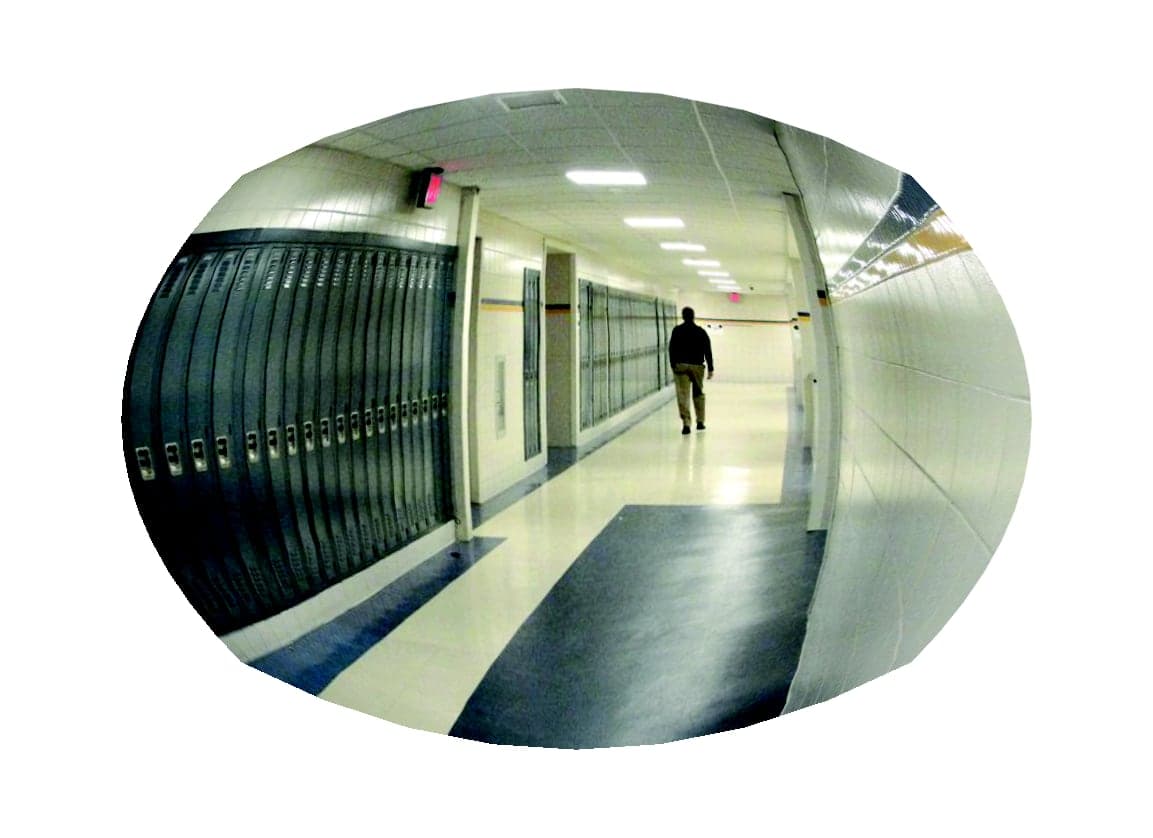
A school hallway during passing period is a few hundred people moving in both directions through a corridor with lockers on both sides and a 90-degree turn at the end. A staff member standing at one intersection can see one hallway. The manufacturer's school brochure describes its mirrors as designed to make concealed areas visible, and that is the whole job: the corner where the fight starts, the alcove by the restroom, the stairwell landing, and the stretch of hallway behind the staff member's back.
Schools also have a problem other buildings do not, which is that anything mounted at hallway height will be hit, hung from, and thrown at. The brochure lists the features that matter for that: acrylic rather than glass, lightweight, maintenance-free, about 20 percent brighter than glass, easy to install, and shatterproof. For the spots that take real abuse, polycarbonate is the upgrade; it is roughly 250 times the impact strength of glass and does not crack.
This page covers the three zones in the brochure plus the outdoor spots that every school has: the bus loop, the parent pickup lane, the parking lot exit onto the street, and the loading dock behind the cafeteria. The same layout works for elementary through high school, and for a community college building with the same corridor plan.
Where the blind spots are
Where school blind spots are, and what to mount there
The brochure's three zones first, then the outdoor spots.
Spot 1
Hallway intersections
- The problem
- Two corridors cross and a staff member on hall duty can see one of them. The corner by the lockers, the restroom alcove, and the turn toward the gym are where things happen out of sight.
- The mirror
- A dome mirror at the ceiling of each intersection. A 180-degree half dome on the far wall of a T shows both directions of the cross hall; a 360-degree full dome at a four-way crossing shows all four. For a long straight hall with a corner at the end, a 26- or 30-inch indoor convex mirror on the wall at the corner shows the whole length. Mount everything at the ceiling line, above reach.
Spot 2
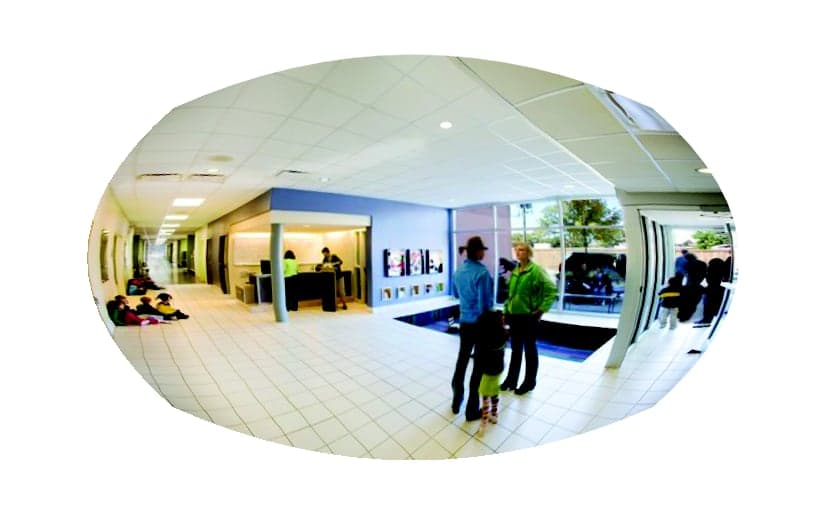
Entrance and exit vestibules
- The problem
- The main entrance is a vestibule with a second set of doors, and the office window looks at the inside doors, not the outside ones. Staff cannot see who is standing in the vestibule or coming up the walk.
- The mirror
- A convex mirror in the vestibule ceiling corner, angled so the office window sees the outer doors, and an Office-Eye at the office window if the angle is tight. At exits used for dismissal, a half dome over the doors shows staff the crowd on both sides.
Spot 3
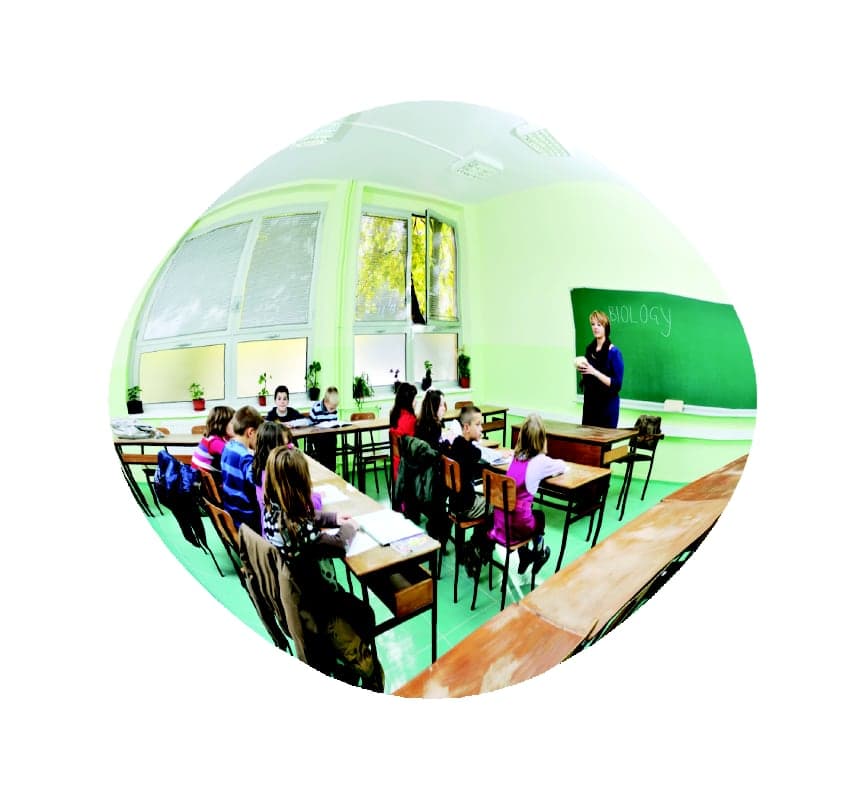
Classroom doors onto a corridor
- The problem
- A classroom door opens outward onto a hallway. A teacher stepping out, or a student sent to the office, walks into passing-period traffic without seeing it. Inside the room, the teacher at the board cannot see the door or the back corner.
- The mirror
- An Office-Eye on the corridor wall across from the door, at eye level, so the person in the doorway sees both directions. Inside a large classroom, lab, or shop, a small convex or quarter dome in the back corner lets the teacher see the whole room from the front. The brochure specifically lists classrooms as a place these mirrors are effective.
Spot 4
Stairwells
- The problem
- Stairwell landings are enclosed, out of camera view, and have a door at each level that opens onto the stairs. Students coming down meet students coming in.
- The mirror
- An 18-inch polycarbonate convex mirror on the landing wall above each door, aimed down the flight. Polycarbonate because stairwell mirrors get hit. Mount at the ceiling line so it is out of reach from the stairs.
Spot 5
Bus loop, pickup lane, and parking lot exit
- The problem
- Buses pull out of the loop into the pickup lane, parents pull out of the pickup lane into the lot, and the lot exits onto a street, all at the same twenty minutes twice a day, with students walking through the middle.
- The mirror
- An outdoor convex mirror at the bus loop exit and at the parking lot exit onto the street, on a post or the building, so drivers see the lane they are entering. Use a 30- or 36-inch mirror on a heavy-duty plastic or galvanized steel back with telescoping brackets. A safety-border version with the striped rim works well at the crosswalk between the lot and the building.
Spot 6
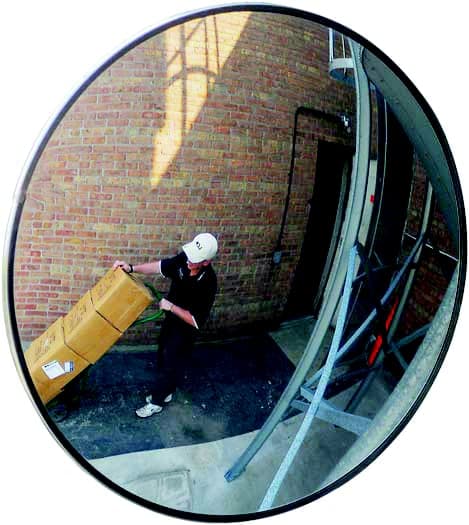
Cafeteria loading dock and maintenance yard
- The problem
- Delivery trucks back into the dock behind the cafeteria, where kitchen staff cross on foot and the dumpster enclosure hides the corner.
- The mirror
- An outdoor convex on the dock wall aimed at the apron, so the driver sees people on foot before backing. 26 inches is typical.
Recommended mirrors
Mirrors we recommend for schools
These match the manufacturer's school brochure, with polycarbonate options for the spots that get hit. All are made to order in the USA and ship with mounting hardware.
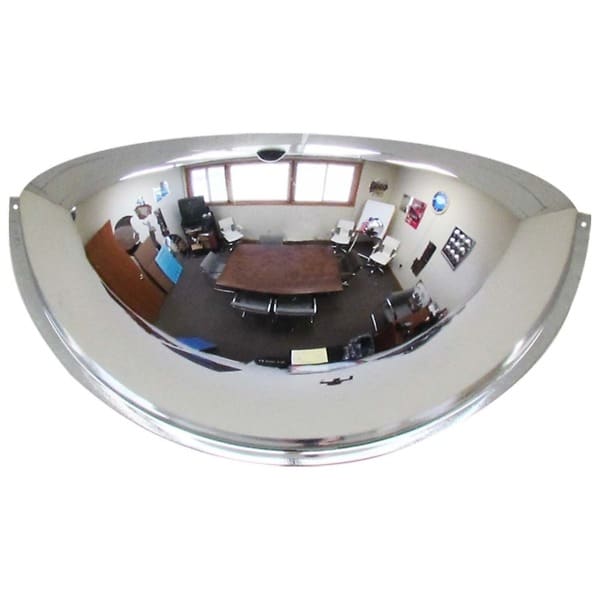
Dome Mirrors , Full Dome, Half Dome, & Quarter Dome Mirrors
Security Mirror: 180° Half Dome Acrylic Safety Mirror
- 18 inch
- 26 inch
- 32 inch
Why for schools: The hallway T-intersection mirror. Mounts at the ceiling on the far wall and shows both directions of the cross hall. Out of reach at ceiling height.
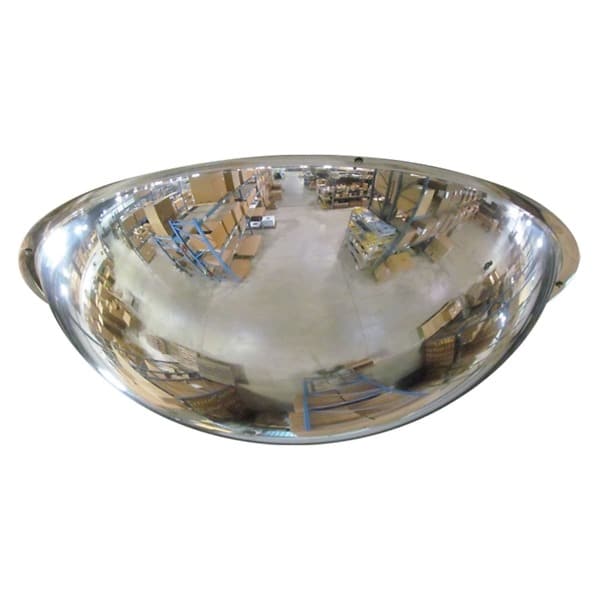
Dome Mirrors , Full Dome, Half Dome, & Quarter Dome Mirrors
360° Full Dome Acrylic Safety Mirror
- 8 inch
- 18 inch
- 26 inch
Why for schools: For four-way hallway crossings and the commons. One dome in the ceiling covers every approach.
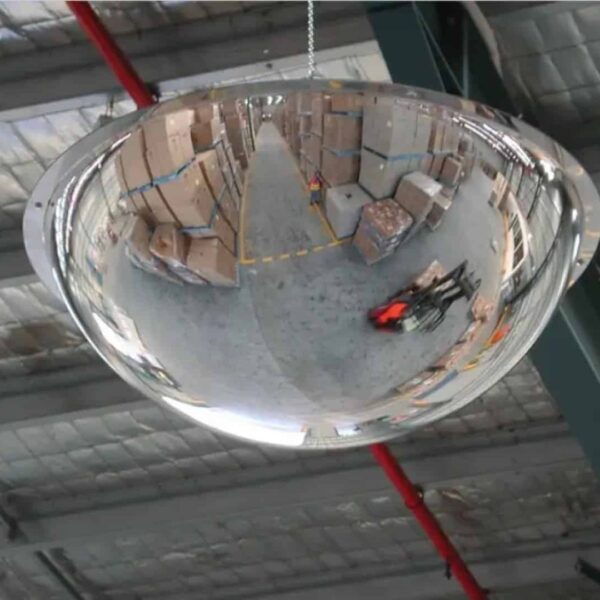
Dome Mirrors , Full Dome, Half Dome, & Quarter Dome Mirrors
360° Polycarbonate Dome Mirror - Shatterproof
- No Backing
- Hardboard
- Full Dome
Why for schools: For the intersections that take abuse. A polycarbonate dome mirror does not crack when it is hit with a backpack or a ball.
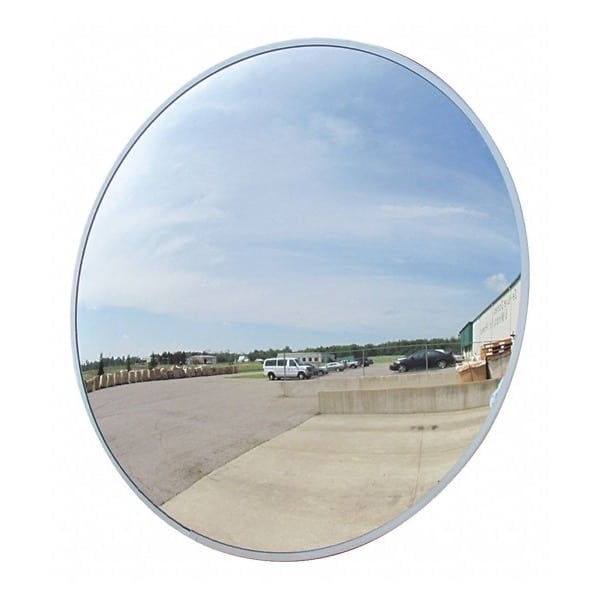
Indoor · Polycarbonate · Hardboard
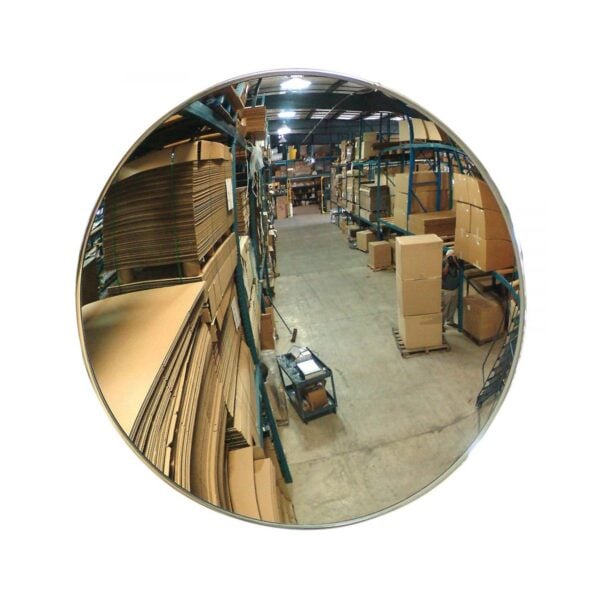
Polycarbonate Convex Mirror — Hardboard Back (Indoor)
- 250× stronger than glass
- 12″–30″
- Anti-vandal
Why for schools: For stairwells, the gym corridor, and anywhere a mirror is within reach. About 250 times the impact strength of glass.
Indoor · Acrylic · Hardboard
Indoor Acrylic Convex Mirror — Hardboard Back
- 160° view
- 12″–36″ sizes
- Z-bracket included
Why for schools: For long straight halls with a corner at the end, and for the entrance vestibule. Acrylic on a hardboard back, 12 to 36 inches, Z-bracket included.
Dome Mirrors , Full Dome, Half Dome, & Quarter Dome Mirrors
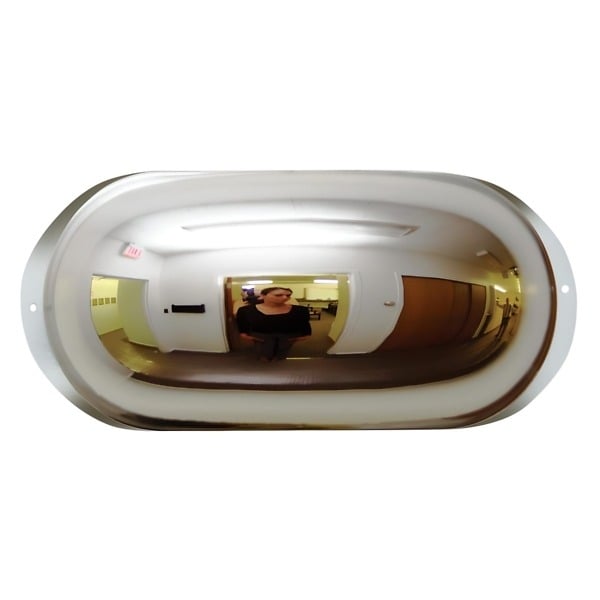
Se-Kure Office Eye-Oval Safety Mirror | 17" Convex Acrylic | Hallway & Elevator Security
- Ready to order
- 1 product images
- Built for safety visibility
Why for schools: For classroom doors and the office window. Eye-level, 17 inches wide, mounts with screws or adhesive.
Outdoor · Acrylic · Heavy-duty plastic
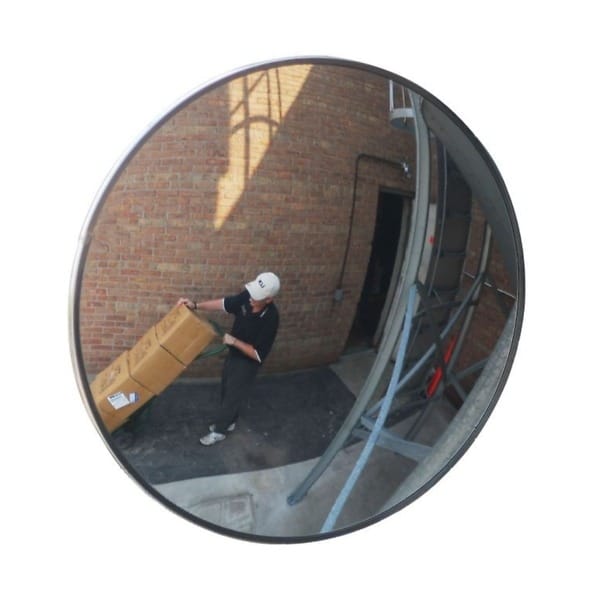
Outdoor Acrylic Convex Mirror — Heavy Duty Plastic Back
- Weather-resistant
- 12″–36″
- Telescoping bracket
Why for schools: For the bus loop, parking lot exit, and loading dock. Heavy-duty plastic back and telescoping brackets for weather.
Traffic · Polycarbonate · Steel
Polycarbonate Convex Traffic Mirror with Steel Backing
- DOT-style traffic spec
- 18″–36″
- Pole-mount ready
Why for schools: For the parking lot exit onto a public street, where the mirror is exposed to weather, wind, and the occasional thrown object.
Sizing
Sizing school mirrors
Corridor mirrors are sized to the corridor width and ceiling height. Outdoor mirrors are sized to the distance between the driver and the mirror.
| Location | Recommended mirror | Size |
|---|---|---|
| Hallway T-intersection, 8–10 ft ceiling | Half dome | 18″ (26″ for a wide hall) |
| Four-way crossing or commons | Full dome | 26″ or 36″ |
| Long hall with a corner at the end | Indoor convex | 26″ or 30″ |
| Stairwell landing | Polycarbonate convex | 18″ |
| Classroom door / office window | Office-Eye | 17″ × 8.5″ |
| Bus loop or lot exit | Outdoor convex | 30″ or 36″ |
| Loading dock | Outdoor convex | 26″ |
School corridors are often wider and taller than office corridors. When the hall is over 10 feet wide, go to the 26-inch dome.
Mounting
Mounting in a school
School walls are usually painted block, and ceilings are either a grid or exposed deck. Both are easy, and the mirrors are light enough for one person.
- 1
Mount above reach
Hallway mirrors go at the ceiling line, at least eight feet to the bottom edge, so they cannot be pulled down or hung from. Domes mount flat to the ceiling or high on the wall with the screws provided.
- 2
Anchor into block
Use plastic or sleeve anchors in the block face, not the mortar joint. Z-brackets take two anchors; the half dome flange takes four.
- 3
Office-Eye on the corridor side of classroom doors
Mount at eye level, about 60 to 66 inches to center, on the wall across from the door. Use the screw holes rather than adhesive on block; adhesive holds on smooth painted surfaces but not on textured block.
- 4
Outdoor mirrors on posts
At the bus loop and lot exit, mount to a sign post or a dedicated post with the telescoping bracket that comes with the outdoor mirror. Set the mirror above eight feet so a bus mirror clears it.
- 5
Purchasing
National Safety Mirror is a service-disabled veteran-owned small business registered in SAM.gov. We accept school district purchase orders; see the government contracting page for the UEI and CAGE code.
In place
What the mirror sees in a school
Questions
Questions we get about schools
Where should safety mirrors go in a school?
The manufacturer's brochure names hallways, entrance and exit areas, and classrooms. In practice: a half or full dome at the ceiling of every hallway intersection, a convex in the entrance vestibule so the office can see the outer doors, an Office-Eye across from classroom doors that open onto a busy corridor, a polycarbonate convex on each stairwell landing, and outdoor convex mirrors at the bus loop and parking lot exit.
Are school safety mirrors made of glass?
No. They are acrylic or polycarbonate. Acrylic is lightweight, shatter-resistant, and about 20 percent brighter than a glass mirror of the same size. Polycarbonate is the upgrade for spots that get hit; it is roughly 250 times the impact strength of glass and will not crack.
Acrylic or polycarbonate for a school hallway?
Acrylic at the ceiling line, where the mirror is out of reach. Polycarbonate anywhere within reach or in a stairwell, gym corridor, or locker bay where things get thrown. The polycarbonate dome and the polycarbonate convex are the two products for those spots.
How high should a hallway mirror be mounted in a school?
At the ceiling line, with the bottom edge at least eight feet up, so it cannot be reached from the floor or hung from. Office-Eye mirrors at classroom doors are the exception; they mount at eye level because they are read by the person standing at the door.
What mirror goes at a school bus loop?
An outdoor convex mirror, 30 or 36 inches, on a heavy-duty plastic or galvanized steel back with telescoping brackets, mounted on a post at the loop exit so the bus driver sees the pickup lane before pulling out. Set it above eight feet so bus mirrors clear it.
Can a school district buy on a purchase order?
Yes. National Safety Mirror is a service-disabled veteran-owned small business registered in SAM.gov with a UEI and CAGE code, and we accept district and public agency purchase orders. Details are on the government contracting page.
Other facilities
Mirrors for other kinds of buildings
Hospitals & Healthcare
Hospital corridors are where beds, meal carts, wheelchairs, and staff in a hurry meet at right angles with no line of sight.
See the mirrors
Parking Garages
A parking garage needs a convex mirror at every point where a driver has to commit to a turn without seeing what is around it: ramp turns, the exit onto the street, aisle corners at colum…
See the mirrors
Swimming Pools
A pool safety mirror is an acrylic convex mirror on a plastic back mounted where a lifeguard or a parent cannot see: behind a water slide, under the guard chair, around a column or a wall…
See the mirrorsRelated guides
Guides that go with this page
Lens material guide
Acrylic versus polycarbonate for the spots that get hit.
Dome mirror sizing guide
Matching dome diameter to a wide school corridor.
Government and school purchasing
UEI, CAGE, and purchase-order details for districts.
Shop the categories
Every mirror on this page, by category
Dome mirrors
Half, full, and polycarbonate domes for hallway intersections.
Convex mirrors
Acrylic and polycarbonate convex mirrors for halls, stairwells, and vestibules.
Traffic mirrors
Outdoor mirrors for the bus loop and parking lot exit.
Placement and sizing on this page follow the application sheets published by the manufacturer of our mirrors, Se-Kure Domes & Mirrors, and the specifications of the products in our catalog. Sizes and materials named here are the ones we stock; if your building needs something the sheet does not cover, call and we will work it out with you.
Free sizing help
Send us a photo of the corner and we will tell you what fits
A picture from where the person stands, plus a rough distance to the spot you cannot see, is usually enough for us to name the mirror, the size, and the bracket.