Dome Mirror Mounting Options
Published July 27, 2026 - Last updated October 5, 2026
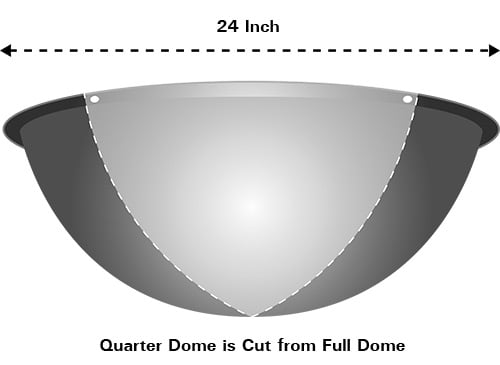
Dome mirrors come in four formats — quarter, half, three-quarter, and full — and each one is built for a specific mounting position. Get the format right and a single mirror covers an entire intersection. Get it wrong and a wall ends up blocking half of what the mirror was meant to show.
Format-by-format mounting reference
| Dome format | Coverage | Mount position | Best for |
|---|---|---|---|
| Quarter dome | 90° | Outside wall corner | L-shape aisle ends, building corners, security checkpoints |
| Half dome | 180° | Flat wall or aisle end | T-intersections, retail aisle ends, hallway transitions, dock door approaches |
| Three-quarter dome | 270° | Wall-ceiling transition | Three-way transitions, hallway-to-room openings, mixed approach areas |
| Full dome | 360° | Ceiling, centered overhead | Four-way intersections, open retail floors, warehouse hub points, distribution centers |
Mount height by application
| Application | Recommended height | Recommended dome |
|---|---|---|
| Hallway corner / aisle end | 7–8 ft | 18" quarter or half |
| Retail intersection | 8–10 ft | 24"–32" full or three-quarter |
| School / hospital corridor | 8–10 ft | 24" half or three-quarter |
| Warehouse 4-way intersection | 10–12 ft | 32"–36" full |
| Distribution-center hub | 12–14 ft | 36"–48" full |
Higher mounts cover more floor area at the cost of per-square-foot detail. If you can't see fine detail in the mirror at the decision point, drop the mount height by 1–2 feet or step up to a larger dome.
Picking the right format
Start with the approach count. Walk to the spot you want the mirror to cover and count the directions traffic comes from. One direction = a convex mirror is a better fit. Two directions converging at a corner = quarter dome. Two converging at a wall-adjacent T = half dome. Three converging at a transition = three-quarter dome. Four converging at an open intersection = full dome.
Then check the mount surface. Quarter, half, and three-quarter domes mount to walls or wall-ceiling transitions. Full domes need a ceiling — chain-suspended or flush-mounted at the intersection center. If your four-way intersection doesn't have a ceiling within reach (open warehouse mezzanines, outdoor canopies), use multiple corner-mounted half domes instead of trying to suspend a full dome.
Finally, validate after install. Stand at each approach direction and confirm you can see all relevant traffic in the mirror. If one direction has a blind spot, the dome format is wrong for the intersection — the fix is usually stepping up from quarter to half, or half to three-quarter, not buying a bigger dome of the same format.
Frequently asked questions
What's the difference between quarter, half, three-quarter, and full dome mirrors?
The number describes the dome's coverage angle. Quarter domes cover 90° and mount at outside corners. Half domes cover 180° and mount at walls or aisle ends. Three-quarter domes cover 270° and mount at transitions where three approach directions need coverage. Full domes cover 360° and mount overhead at four-way intersections.
How high should a dome mirror be mounted?
Mount full domes at ceiling height — typically 10 to 14 feet for warehouse and retail intersections, 8 to 10 feet for hallways and smaller interiors. Quarter, half, and three-quarter domes mount at the wall-ceiling transition, usually 7 to 10 feet above the floor. Higher mounts cover larger floor areas but reduce per-square-foot detail.
Can a full dome mirror be mounted to a wall?
It's possible but rarely the right choice. Full domes are designed to give 360° coverage from a centered overhead position. Mounting one to a wall wastes the half of the dome that faces the wall. If your intersection is wall-adjacent, a half or three-quarter dome is almost always the better fit.
Do dome mirrors need a special mounting kit?
No — dome mirrors do not use brackets. Each ships with the hardware its format needs. Quarter, half, and three-quarter domes come with screws and wall anchors to mount flush through their pre-drilled flange, and backed versions instead hang on the backing's D-rings over two anchored screws. Full domes include screws and anchors for a flush ceiling mount plus S-hooks and chain to hang them as a pendulum. Confirm the format before ordering, especially for ceilings with limited load capacity or installations that need tamper-resistant hardware.
What size dome do I need for a four-way warehouse intersection?
For a typical four-way warehouse forklift intersection at 12 feet of ceiling height, a 32 to 36 inch full dome covers the intersection plus a useful margin in each approach direction. Larger distribution-center hubs with longer sightlines often step up to 48-inch full domes, especially when ceiling height is 14+ feet.
Can dome mirrors be used outdoors?
Most dome mirror applications are indoor — retail, warehouse, school, hospital, office. Outdoor dome installations exist but are uncommon; for outdoor traffic, driveway, and parking visibility, a polycarbonate convex mirror with HDPE or galvanized steel backing on a telescoping bracket is almost always the better fit.
Need help picking the right dome format?
Send NSM the intersection layout (number of approach directions, ceiling height, wall surfaces) and we'll recommend quarter, half, three-quarter, or full plus the right diameter — and quote bulk and government orders the same business day.
Mounting details
How each dome mirror mounts
Start with the mirror shape, then check whether it has a backing or cover. Domes without backing mount through predrilled flange holes. Covered or backed domes hang from D-rings on the back cover.
| Dome type | Backing | Sizes | Mounting method | Hardware notes | Manual |
|---|---|---|---|---|---|
| Full dome | No backing | 18" and 26" | Predrilled holes around the flange for direct ceiling mounting. | Also includes 4 S-hooks and 3 chains for suspended/pendulum mounting. | Full Dome 18" and 26" |
| Full dome | No backing | 32", 36", and 48" | Predrilled holes around the flange for direct ceiling mounting. | Also includes 4 S-hooks and 3 chains for suspended/pendulum mounting. | Full Dome 32", 36", and 48" |
| Full dome | With cover/backing | All covered full domes | Three D-rings on the back of the cover/backing. | Includes 4 S-hooks and 3 chains for hanging. | Full Dome with Cover |
| Half dome | No backing | 18" and 26" | Three predrilled holes along the flange for wall or ceiling-edge mounting. | Fasten through the flange into anchors, blocking, or studs. | Half and Quarter Dome 18" and 26" |
| Half dome | No backing | 32", 36", and 48" | Three predrilled holes along the flange for wall or ceiling-edge mounting. | Fasten through the flange into anchors, blocking, or studs. | Half and Quarter Dome 32", 36", and 48" |
| Quarter dome | No backing | 18", 26", 32", 36", and 48" | Three predrilled holes along the flanges for inside-corner mounting. | Fasten through both flanges into anchors, blocking, or studs. | Half and Quarter Dome manuals |
| Half or quarter dome | With cover/backing | All covered half and quarter domes | Two D-rings on the back cover/backing. | Hang the D-rings on two properly anchored screws. | Half and Quarter Dome with Cover |
| 270 degree corner dome | No backing | Corner dome | Three predrilled holes in the flanges for outside-corner mounting. | Fasten through the flanges into anchors, blocking, or studs. | 270 Dome |
| 270 degree corner dome | With cover/backing | Corner dome with dust cover | Two D-rings on the back cover/backing. | Hang the D-rings on two properly anchored screws. | 270 Dome with Dust Cover |
For suspended full domes, anchor into a structure that can carry the mirror; do not rely on a loose ceiling tile alone. For flange-mounted half, quarter, and 270 degree domes, choose anchors for the actual wall, corner, blocking, or ceiling material.
Related resources
Keep moving through the right support pages
Use the connected NSM policy and help pages below instead of backing out to search again.
90-degree corner dome mirrors
Quarter domes mount tight into corners where two approach paths need visibility.
270-degree outer-corner domes
Use 270-degree domes for outside corners, columns, and wraparound intersections.
Full 360-degree dome mirrors
Full domes fit open four-way intersections and overhead central mounting.
Polycarbonate dome mirrors
Impact-resistant dome mirrors for schools, warehouses, public corridors, and rougher facilities.