01Selection path
- Environment
- Outdoor
- Hazard
- Blocked exit
- Start with
- Traffic mirror
Driveway exits
Help cars, trucks, and service vehicles see around landscaping, walls, and street-edge obstructions before pulling out.
Outdoor Traffic Safety
1
goal: safer pulling and turning
3
main placement patterns
24/7
visibility concerns in active lots
6 products
showing all results
No products match these filters.
Try removing a filter or browse all products in this category.
Clear filtersFree sizing help
Send us a photo and an American-based specialist can usually recommend the exact model, size, and mount for your space — free, with no obligation.
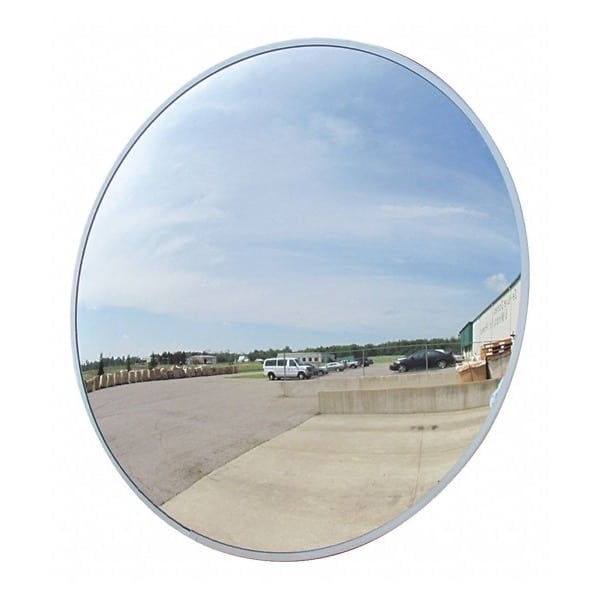
For blind exits, landscaping, fences, walls, and parked vehicles where HDPE backing and a telescoping mount usually fit.
For fleet yards, loading areas, public-road exposure, and higher-impact routes that need polycarbonate and steel backing.
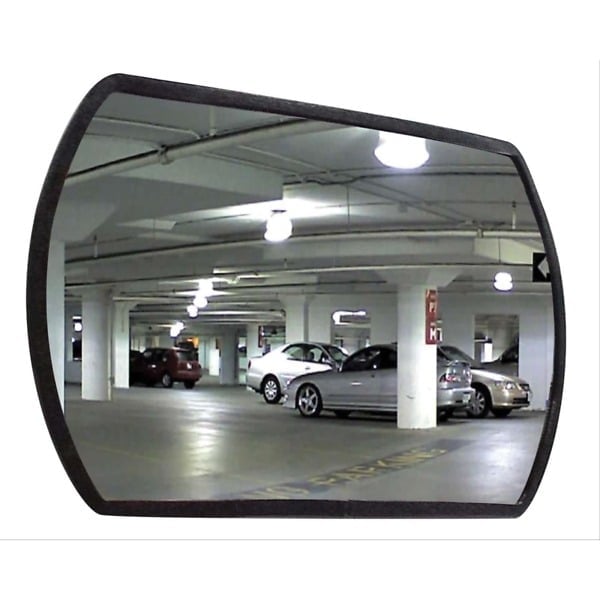
For parking garages, narrow lanes, building corners, and outdoor locations where a rectangular view fits better.
Use the mounting guide when the question is pole vs wall, arm count, wind load, or how far the mirror must project.
Identify whether the issue is a blind exit, building corner, cross traffic, or line-of-sight obstruction.
Outdoor mirrors need the right backing and bracket choices to hold up in wind, rain, and changing temperatures.
Mirror size should support the distance at which drivers need to react, not just the available mounting area.
Pole, wall, and telescoping installations change how the mirror performs and how easy it is to position correctly.
By application
Help cars, trucks, and service vehicles see around landscaping, walls, and street-edge obstructions before pulling out.
Improve visibility where walls, gates, and fences block lines of sight for vehicles or mixed pedestrian traffic.
Support safer movement in loading zones, lots, campuses, and industrial traffic lanes with frequent turning activity.
Placement strategy
Best when the obstruction is the structure itself
Best when the viewing point must move away from the structure
Outdoor sizing reference
Outdoor traffic mirrors size up faster than indoor mirrors because vehicle approach speeds compress reaction time. Use the 1:1.5 rule as a starting point, then add a size if vehicles approach faster than 15 mph or if the mirror has to clear a fence, post, or landscaping.
| Mirror diameter | Driver reaction distance | Best for |
|---|---|---|
| 18"–24" | Up to 27–36 ft | Residential driveways, short driveway exits, low-speed lot turns |
| 26"–30" | 39–45 ft | Commercial driveway exits, fence-line corners, parking-lot intersections |
| 32"–36" | 48–54 ft | Loading-dock approaches, school drop-off lanes, fleet-yard intersections |
| 36"–48" | 54–72 ft | Public-road intersections, long industrial sightlines, distribution-center main routes |
Vehicle speed matters as much as distance. Up-size by one tier if approach speeds exceed 15 mph or if the obstruction blocks more than half of the natural sightline.
Outdoor durability
Standard outdoor build for most installations
Heavy-duty build for high-impact and high-wind installations
Bracket selection
Lighter mirrors and shorter reach from the structure
Larger mirrors, longer reach, exposed installations
Residential driveway mirrors solve line-of-sight obstructions from landscaping, walls, fences, and parked vehicles. A 24"-30" outdoor acrylic convex mirror with HDPE backing on a single-arm telescoping bracket solves most residential blind exits when mounted so drivers see oncoming traffic before pulling out.
Commercial parking and loading areas need larger traffic mirrors and stronger brackets. A 30"-36" polycarbonate traffic mirror with steel backing gives drivers and forklift operators enough reaction distance for higher approach speeds typical of commercial sites.
Fence-line and building-corner installations should treat the obstruction as the placement constraint, not the wall. Use a telescoping mirror mount with enough reach to push the viewing surface past the corner of the fence or building; otherwise the obstruction blocks part of the view the mirror is meant to provide.
Public-road, school, and municipal installations usually need polycarbonate construction with galvanized steel backing because impact, vandalism, and long-term wind load are realistic concerns. Review HDPE vs galvanized steel backing and acrylic vs polycarbonate mirror lenses before finalizing a spec.
Outdoor traffic almost always wants polycarbonate (~250× glass) for impact rating. Acrylic is fine in sheltered residential.
HDPE handles general outdoor; galvanized steel is the upgrade for extreme weather, public-road exposure, and coastal installs.
Telescoping bracket arm count by mirror size. Wall, pole, and corner mounts — which fits each obstruction.
Outdoor traffic almost always wants convex on a telescoping bracket — but if you have an indoor crossing too, compare formats.
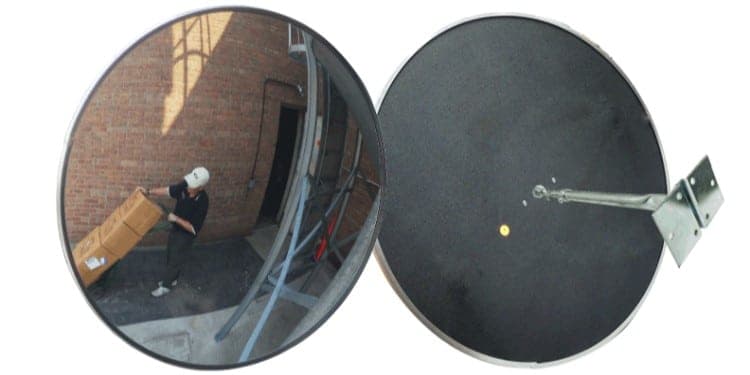
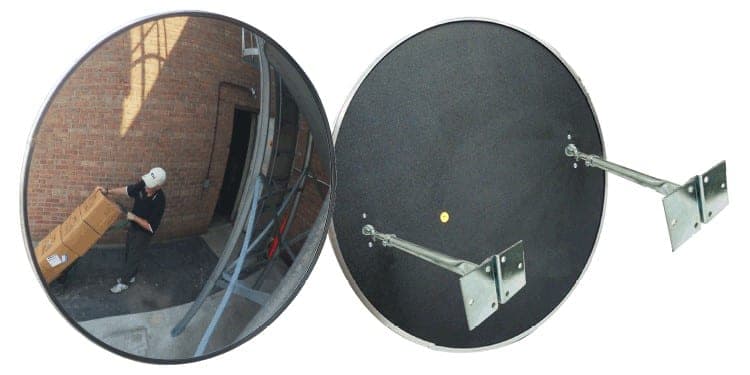
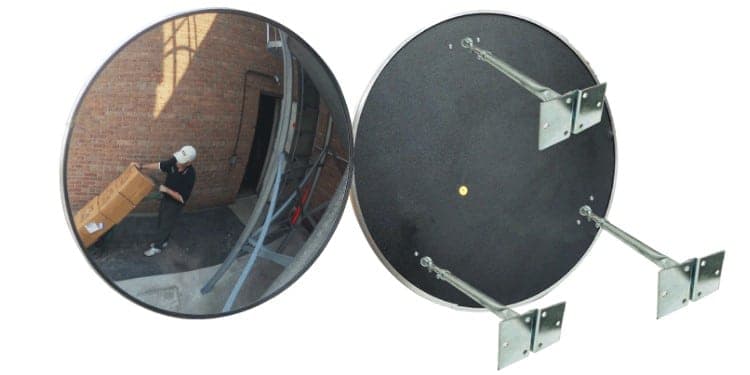
Lightweight and cost-effective but intended for indoor use only. Do not use hardboard on mirrors that will be exposed to rain, humidity, or freeze-thaw cycles.
High-density polyethylene resists moisture, UV, and temperature swings. HDPE is the standard outdoor backing for driveway mirrors, traffic mirrors, and any mirror exposed to the elements.
The heaviest and most durable outdoor option. Galvanized steel is corrosion-resistant and built for high-traffic locations — parking lot exits, loading zones, and exposed pole mounts where impact risk is highest.
Outdoor selection help
Need a recommendation?
If you can tell NSM where the blind spot is, how far away drivers need to react, and whether you need a wall or pole mount, the options usually become much clearer.
Related guides
These links keep this category connected to the matching guide, adjacent mirror family, or installation help page instead of forcing a broad restart.
Use the backing guide when corrosion resistance and weather exposure shape the traffic-mirror decision.
Follow the outdoor bracket and mounting guide before finalizing posts, walls, or building corners.
Mirrors for parking structures, ramps, and tight indoor vehicle turns.
Placement and sizing advice for outdoor driveway and traffic mirrors.
Mirrors by facility
Each page walks one kind of facility: the blind spots, the mirror for each one, the size to order, and how it mounts.
A pool safety mirror is an acrylic convex mirror on a plastic back mounted where a lifeguard or a parent cannot see: behind a water slide, under the guard chair, around a column or a wall…
Hospital corridors are where beds, meal carts, wheelchairs, and staff in a hurry meet at right angles with no line of sight.
The manufacturer's school brochure names three places a mirror belongs: hallways, entrance and exit areas, and classrooms.
A parking garage needs a convex mirror at every point where a driver has to commit to a turn without seeing what is around it: ramp turns, the exit onto the street, aisle corners at colum…