Driveway Mirrors
How a Driveway Mirror Can Help Prevent Accidents by Providing Visibility to Blind Spots
Learn how driveway mirrors improve blind-spot visibility and what to consider before choosing a mirror for a home, farm, shop, or private road exit.
Why this article matters
A straightforward introduction to driveway mirrors and the types of blind-spot problems they solve for homes, shops, farms, and shared entrances.
- Key point: Driveway mirrors help when drivers cannot safely see the full approach from the stop point.
- Key point: Placement should follow the driver view, not just the easiest post or wall location.
- Key point: Outdoor lens, backing, and bracket choices matter as much as mirror shape.
On This Page
Related Categories And Products
A driveway mirror helps when a driver cannot see enough of the approach lane before entering it. That might be because of a wall, hedges, a fence, a hill, or a roadway that curves across the line of sight. The mirror does not remove the need for caution, but it can make the decision much safer.
What Are Blind Spots?
Blind spots are areas that are not visible to a driver when looking out the window, using the rearview mirror or side mirrors. Typically, blind spots are located on either side of the vehicle or behind it. Blind spots can make it difficult for a driver to see other vehicles, pedestrians, cyclists, or obstacles, making it harder to avoid accidents.
How Do Driveway Mirrors Work?
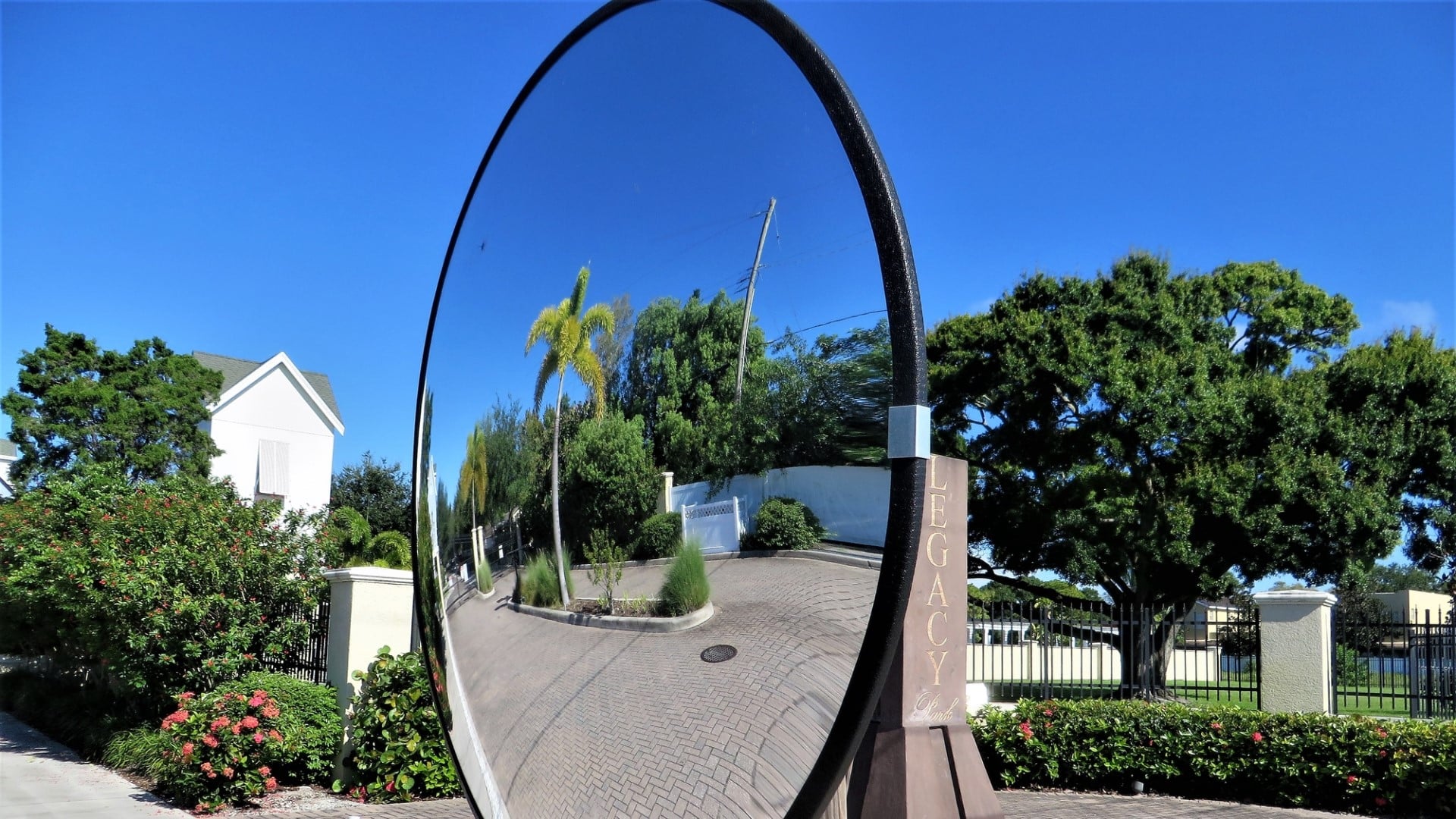
A driveway mirror can give drivers an additional point of view that helps reduce blind spots. Driveway mirrors are convex mirrors, DomeVex mirrors, or “rectangular” mirrors placed at the end of a driveway to provide a wider field of view. These mirrors offer a 160-degree to 180-degree angle view, so a driver can identify anything coming from the right or left.
Driveway mirrors can be attached to a post, fence, tree, or wall and are available in various sizes to accommodate different requirements. A larger driveway mirror is best suited for long and wide driveways, while smaller ones are better for shorter driveways.
The industry-accepted rule of thumb is that every inch in mirror size provides approximately one foot of viewing distance. For example, a 32” circular convex mirror will provide a view of cars from about 32′ away. This is not an exact rule but an approximation.
Benefits of Using a Driveway Mirror
A driveway mirror offers several benefits, including:
Improved Visibility
The primary benefit of using a driveway mirror is improved visibility for the driver. A driver can have difficulty identifying oncoming traffic or pedestrians when backing up, turning, or entering a roadway.
This could be other cars approaching, people, or even pets. The most dangerous are blind curves, where you cannot easily see a fast-approaching car.
A driveway mirror provides a view of the surroundings, reducing the chances of accidents. The mirror is placed at the same height as a standard rearview mirror so it does not obstruct your view of traffic directly behind you.
Safety
A driveway mirror improves safety for everyone who uses the driveway. This includes the driver, passengers, pedestrians, and other motorists. Accidents can happen in a split second and have serious consequences. Using a driveway mirror can help prevent accidents.
The driveway mirror provides a view of the surroundings, so you can see vehicles approaching from behind. This helps prevent accidents caused by blind curves and allows you to make safe decisions about when to pull out onto the street or into your driveway. The mirror is often placed at the same height as a standard rearview mirror, allowing you to see at eye level.
Convenience
Driveway mirrors are easy to install and maintain. They do not require any electrical wiring or batteries, making them a cost-effective solution. Driveway mirrors are also weather-resistant, making them suitable for all weather conditions.
The most common type of driveway mirror is an acrylic mirror. Acrylic mirrors are fifteen times more impact-resistant than glass but provide the same clear view as a glass mirror. The most common backing offered by National Safety Mirror is the “heavy-duty plastic back,” which is constructed from high-density polyethylene, or HDPE. HDPE is durable, weather resistant, and should last for years.
Conclusion
Driving carries risk, but a driveway mirror can give drivers an additional perspective that reduces blind spots and lowers the chances of accidents. A driveway mirror is a simple, cost-effective, and practical way to make your driveway safer. By using one, you can help protect yourself and others who use your driveway.
A driveway mirror is a safety device that many property owners find worth installing. It offers improved visibility, safety, and convenience. The installation process is simple, and the maintenance cost is minimal. A driveway mirror is one practical step toward a safer driveway.
Next Steps